
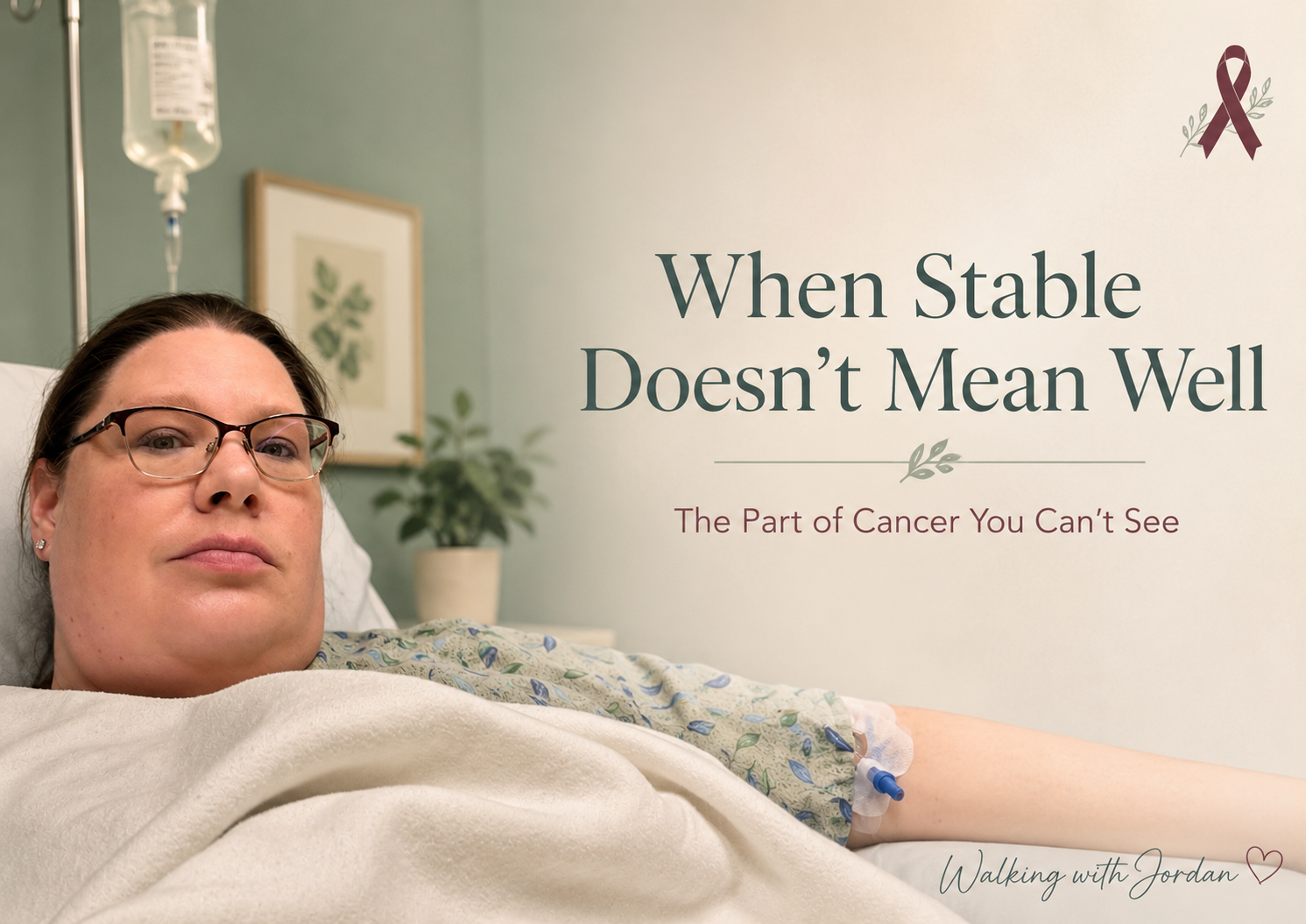
September is Blood Cancer Awareness Month, and when I thought about what I wanted to share this month, I imagined talking about myelofibrosis, treatment, bone marrow biopsies, fatigue, and some of the things I have learned since cancer became part of my everyday vocabulary.
I didn’t expect that two days into the month I would be writing about another emergency room visit.
The truth is, though, this story didn’t begin in the ER. It started several days earlier with the blood work from my most recent bone marrow biopsy.
My calcium came back at 6.9 mg/dL.
That result led to an initial calcium infusion, and I went home hoping we had started correcting the problem. On Monday, I followed up with my primary care physician and had my labs checked again.
My calcium had only increased to 7.4 mg/dL.
That blood work also showed a parathyroid hormone, or PTH, level of 14 pg/mL. I have not been diagnosed with a parathyroid disorder, and at this point there are still questions about why my calcium dropped so low and why it has been slow to recover. The PTH result is simply another piece of the puzzle my doctors will have to consider as they work toward an answer.
I have been incredibly fortunate in my relationship with my PCP. He knows that my medical picture has become complicated, and he doesn’t dismiss something simply because there isn’t an easy explanation for it. He listens, asks questions, follows the numbers, and continues trying to get me where I need to be when something isn’t right. I know he cares about my well-being, and I know he is doing everything he can to advocate for me and help me navigate all of this.
By Wednesday, the symptoms were becoming much harder to ignore.
My legs were tingling. I had a heavy headache and was lightheaded. I was exhausted, and there was this strange feeling of disconnection that is difficult to explain unless you have experienced it yourself. I was physically present and able to carry on a conversation, but my mind felt several steps behind the rest of me.
And yet, I still had every intention of pushing through it.
That probably says as much about living with chronic illness as any laboratory result ever could.
When you live with symptoms long enough, you learn how to function around them. You adjust. You sit down for a few minutes and get back up. You convince yourself the headache will pass. You tell yourself you are tired because you didn’t sleep well. You wait for the tingling to stop. You decide you can make it through one more meeting, one more errand, one more chore, one more day.
I knew my calcium had been low. I knew the first infusion had not brought it back into the normal range. I knew I didn’t feel right.
And I was still planning to keep going.
Sometimes that determination is necessary. Sometimes it is also the reason we need people around us who care enough to tell us, “No. This time you need to stop.”
My PCP was one of those people Wednesday. He wanted me evaluated in the emergency room.
So I went.
When the Tests Are Good but You Still Aren’t
Emergency rooms are designed to look first for the things that can immediately threaten your life, so the testing began.
A CT of my head showed no bleeding, stroke, swelling, or mass. My chest X-ray was clear. My D-dimer was not elevated and helped make a blood clot less likely. My troponin T showed no evidence of acute heart injury, and my EKG showed a normal sinus rhythm with a heart rate of 78.
Then came the blood counts—the numbers I have learned to watch more closely than I ever imagined I would.
My hemoglobin was 10.1 and my platelets were 228.
For most people, hearing that a hemoglobin of 10.1 is “stable” probably sounds strange. For someone living with primary myelofibrosis and chronic anemia, stable has taken on an entirely different meaning.
My CBC was close to the range where it has been, which was reassuring from a myelofibrosis standpoint.
That was genuinely good news.
There is a special kind of relief that comes from lying on an emergency room bed with a pounding head and hearing that your brain scan is clear. I was grateful my heart looked good. I was grateful my lungs were clear. I was grateful there was no obvious evidence pointing toward a blood clot. I was grateful that my blood counts were holding relatively steady.
But chronic illness teaches you something else too.
Good news does not always mean you feel good.
You can have a clear CT and still know something is wrong. You can receive reassuring test after reassuring test while your body continues telling you that something isn’t right.
And you can hear the word stable while still being very much sick.
My calcium in the ER was 7.5 mg/dL.
After starting at 6.9 mg/dL, receiving an infusion, and then measuring 7.4 mg/dL at my PCP appointment, it still had not returned to the normal range.
There are still questions about why my calcium dropped so significantly and why it has been slow to recover. The PTH result from earlier in the week may eventually help provide part of that answer, or there may be something else my doctors need to investigate.
For now, the immediate problem was what was right in front of us: a persistently low calcium level accompanied by symptoms I could no longer pretend weren’t affecting me.
The ER team ultimately gave me IV fluids and a slow infusion of calcium gluconate.
Gradually, things began settling down. The tingling eased. The strange disconnected feeling began clearing. My body started feeling a little more like mine again.
The Problem With Looking Fine
There was a point during the visit when there was discussion about whether IV calcium was necessary or whether I could simply go back to the hotel and continue managing it orally.
I understood why.
Most of the frightening possibilities had been ruled out. My scan was clear. My heart was okay. My lungs were okay. My blood counts were relatively stable. There was no dramatic result flashing across a computer screen announcing an obvious emergency.
But I still wasn’t okay.
That is one of the harder parts of navigating chronic illness. Eventually, you learn enough about your own body and your disease that you have to participate in the conversation about your care.
That does not mean assuming you know more than your doctors or walking into an emergency room demanding a particular treatment. It means learning to explain what is normal for you, what has changed, what has already been tried, and why you are concerned.
It means sometimes having to say, “I know what the tests are showing, but I also know how I feel.”
And maybe just as importantly, it means learning when not to push through.
That might actually be one of the harder lessons for me.
I have spent a lot of my life believing strength meant getting up and doing what needed to be done regardless of how tired I was. Cancer has challenged that definition over and over again.
There are days when strength does mean getting up.
There are also days when strength means admitting that you shouldn’t.
This Is Blood Cancer Awareness Too
When we talk about cancer awareness, people naturally picture some of the more visible parts of the disease—treatment centers, chemotherapy chairs, scans, hair loss, hospital stays, ribbons, and fundraisers.
Those things are part of cancer.
But this is part of it too.
Cancer is learning laboratory values you never wanted to understand. It is knowing your hemoglobin without having to look it up. It is comparing this month’s platelet count with last month’s. It is trying to figure out whether today’s exhaustion belongs to the cancer, the anemia, the medication, another medical issue, a bad night of sleep, or simply doing too much the day before.
It is also realizing that once you have cancer, every new symptom comes with another layer of questions.
Is this the cancer?
Is it treatment?
Is something else going on?
Is this something I can push through, or is this the time I finally need to stop?
Sometimes cancer looks like someone sitting in an emergency room who looks perfectly normal to everyone walking past.
Sometimes it looks like answering, “My numbers are stable,” and realizing that people may hear better when what you actually said was not worse.
Those aren’t the same thing.
There was nothing in Wednesday’s ER visit suggesting that my myelofibrosis had suddenly taken some dramatic turn, and I am incredibly thankful for that.
But my hemoglobin is still 10.1. I am still anemic. My bone marrow is still fibrotic. I still take medication every day for a disease that remains part of my life even when the numbers stay exactly where everyone hopes they will stay.
And Wednesday, another part of my body needed help.
This is something I hope people understand during Blood Cancer Awareness Month: cancer does not always announce itself loudly.
Sometimes it changes the amount of energy available for an ordinary Wednesday. Sometimes it determines whether the laundry gets finished, whether the barn gets cleaned, whether dinner gets cooked, or whether an afternoon requires a nap that wasn’t part of the plan. Sometimes it means calculating how much energy something will cost before deciding whether you can do it.
And sometimes the victory isn’t hearing that you are getting better.
Sometimes the victory is simply hearing that you aren’t getting worse.
I am learning to be grateful for those victories too.
When Strength Means Something Different
As I thought about Wednesday, I kept coming back to Isaiah 40.
“He gives power to the weak and strength to the powerless.” — Isaiah 40:29 NLT
There is something about those words that hits differently after a day when I had every intention of simply pushing through.
A few verses earlier, God’s people are weary enough to wonder whether God even sees what they are going through. Isaiah doesn’t answer them by pretending their exhaustion isn’t real. He reminds them who God is. Even the young and strong eventually become tired, but God’s strength does not run out.
Then comes the familiar promise that those who trust in the Lord will find new strength.
For a long time, I think I would have read that passage and focused almost entirely on the running.
Keep going.
Don’t stop.
Push through.
Be strong.
But maybe I have misunderstood strength.
Isaiah isn’t praising people for proving how much they can endure on their own. If anything, the passage exposes the limits of human strength and points us toward a God who doesn’t share those limits.
There is humility in recognizing the difference.
Wednesday, trusting God did not mean walking into the emergency room convinced He would miraculously make my calcium normal before they drew the blood. It didn’t mean refusing treatment because I had enough faith. It didn’t require pretending I wasn’t concerned or that my symptoms weren’t real.
Maybe trusting Him looked much less dramatic than that.
Maybe it looked like listening when my doctor said it was time to go.
Maybe it looked like admitting that I wasn’t going to push through this one.
Maybe it looked like lying in a hospital bed and allowing someone else to take care of me.
Maybe it looked like receiving the IV, being grateful for modern medicine, thanking God when the CT came back clear, and letting that be enough for one day.
That is a very different definition of strength than the one I have carried for most of my life.
Loved, but Still Alone
There is another part of Wednesday I haven’t mentioned.
I’m traveling right now and staying in a hotel away from home, which meant I went to the emergency room by myself.
My family knew what was happening. They were worried, and more than once they were ready to get in the car and come to me. I kept telling them no. I was okay. I could handle it. There was no reason for everyone to make the drive.
At the time, that felt practical.
Last night, sitting alone in this hotel room after everything has quieted down, it felt a little different.
There is a peculiar loneliness in being away from home when something goes wrong. I know I am loved. I know there are people who would have been beside me the moment I asked them to come.
But there was still an empty chair beside the hospital bed Wednesday.
And now there is a quiet hotel room instead of home.
Those things can both be true.
I can be surrounded by people who love me and still feel lonely.
I can know my family would drop everything for me and still wish someone were sitting beside me.
I can have faith and still admit that last night felt a little lonely.
Maybe that is another reason Isaiah’s words feel so personal right now.
God’s presence doesn’t always mean we stop feeling lonely. Faith doesn’t require me to pretend an empty room doesn’t feel empty.
But loneliness and abandonment are not the same thing.
I may be alone in this hotel room, but I do not believe I am abandoned in it.
The same God who was with me through every scan, every needle, every result, and every quiet minute staring at the ceiling in that ER is here too.
Maybe sometimes renewed strength looks like running.
Sometimes it looks like walking.
And sometimes it looks like sitting very still in a quiet room and trusting that God is sitting in the silence with you.
For the Person Who Keeps Pushing
I know I am not the only person who does this.
Maybe you don’t have cancer. Maybe you don’t have a chronic illness at all. But perhaps you are carrying something that has convinced you that stopping means failing.
So you keep going.
You keep working.
You keep taking care of everyone else.
You tell yourself other people have it worse or that you should be able to handle more. You ignore the exhaustion because there is still something on the list that needs to be done.
But God never asked us to prove our faith by pretending we have unlimited strength.
Isaiah reminds us of exactly the opposite.
We don’t.
Even the strongest eventually become weary.
The hope in that passage isn’t that Christians somehow become inexhaustible. The hope is that when our own strength reaches its limit, God’s has not.
I am slowly learning there is faith in recognizing that limit.
There is faith in resting.
There is faith in accepting help.
There is even faith in going to the emergency room when every stubborn part of you would rather keep pushing through.
I am out of the hospital and back in my hotel room. My head CT was clear. My heart looked good. My lungs were clear. My blood counts were stable. I received more calcium and IV fluids, and I left feeling better than when I arrived.
My calcium still needs to be watched, and there are questions that will require follow-up beyond what an emergency room can provide. Chronic illness rarely wraps itself up neatly before you leave the hospital parking lot.
And if I’m truthful, the I wish I were home.
I wish this hotel room weren’t quite so quiet.
But maybe I don’t have to turn that feeling into something more spiritual than it is. Maybe I can simply admit that I feel lonely and still believe God is here.
I don’t have to solve everything that comes next.
I don’t have to manufacture strength I don’t have.
I don’t even have to pretend this part is easy.
Yesterday required enough from me.
So for now I will rest in the quiet, trust the God who doesn’t grow weary, and remember that being alone is not the same as being abandoned.
Then, by His grace, I will get up and keep walking.
Leave a Reply