
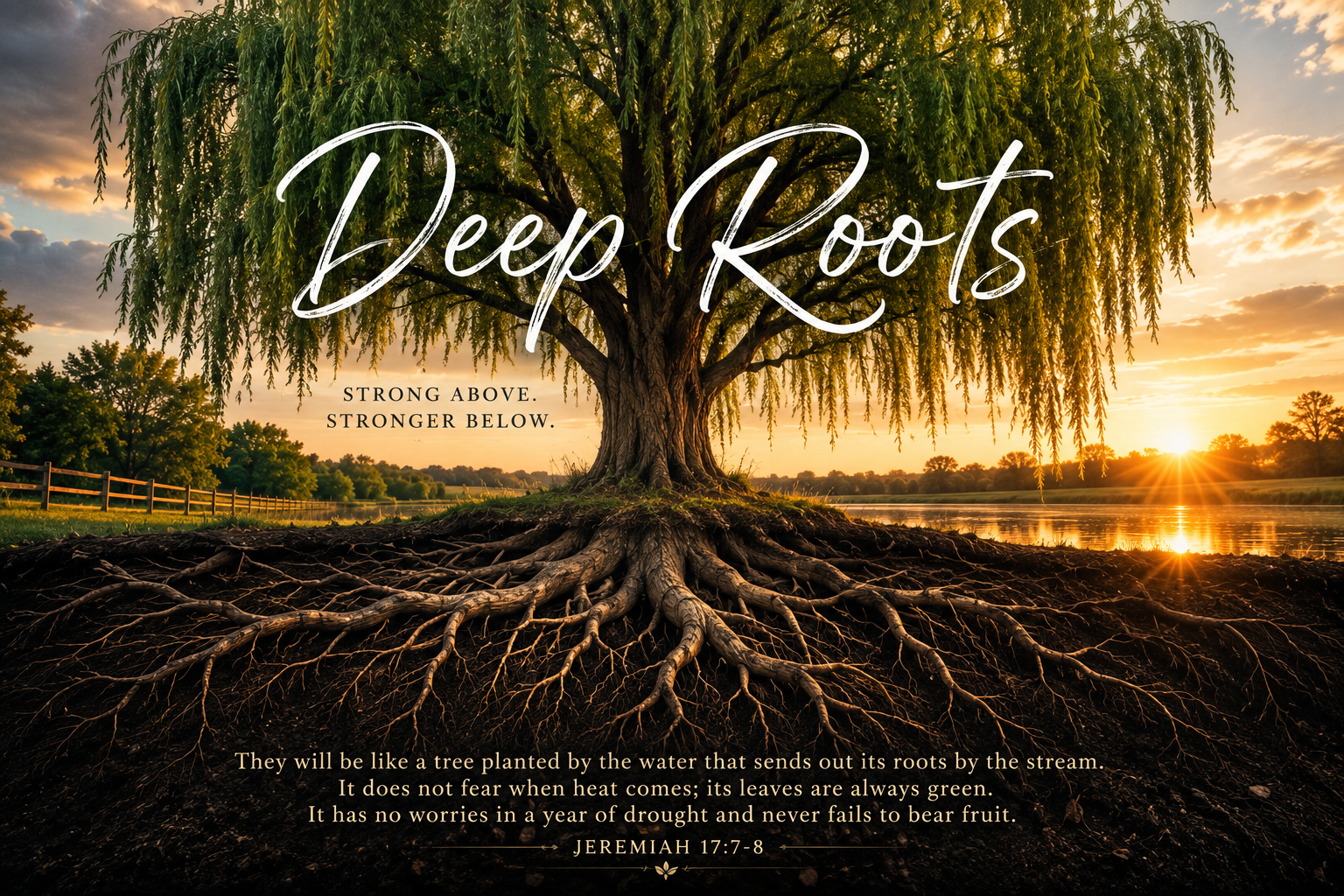
For the past several months, my husband and I have found ourselves having the same conversation: “Where should we plant a weeping willow?”
It usually begins the same way. We’ll be sitting on our porch, looking out over the twenty-five acres we have been blessed to call home. Technically, we lease the property, but we have always believed that whether you own something or are simply entrusted with it for a season, you should care for it as if it were your own. We hope that one day we’ll have the opportunity to purchase it, but until then, we want to leave it better than we found it.
As we look across the property, our eyes naturally begin searching for the perfect place. We already have beautiful trees scattered throughout the land, but there is something different about a weeping willow.
Maybe it’s the elegance. Maybe it’s the way its long branches seem to dance effortlessly with every breeze. Maybe it’s the peaceful feeling it brings just by standing beneath it. Or maybe it’s because every time I see one, I’m reminded of my past. I can still picture the willow trees at my parents’ house, watching our dogs run circles through the yard while we played beneath their branches. It’s funny how certain trees can hold memories just as much as photographs do.
When I close my eyes, I can already see it: a large willow standing proudly somewhere on our property, its branches stretching all the way to the ground, providing shade on warm summer afternoons, and moving gently with the Arkansas wind.
The only problem is… I have no idea where to plant it.
What Lies Beneath the Surface
At first, that sounds like a simple decision—until you start learning about weeping willows. They aren’t trees you simply stick in the ground and hope for the best. Their roots are incredible. They naturally seek water, stretching far beyond what you can see above the surface. Those roots can travel surprising distances, searching for the streams and moisture that allow the tree to flourish. That’s why experts recommend planting them well away from foundations, septic systems, and underground utilities. If you don’t give those roots enough room, what was meant to become something beautiful can eventually create problems.
The pasture isn’t a good option because we cut it for hay. The back corner won’t work because of the septic system. Another spot is too close to the house. So we keep talking, we keep imagining, and we keep planning. Because when you plant something that you hope will outlive you, where you plant it matters.
The more I thought about it, the more I realized: maybe we’re not just talking about a tree. Maybe God has been teaching me something through the roots.
When storms roll across Arkansas, people often notice the branches bending. They notice the leaves blowing and the trunk standing against the wind. What they rarely notice is the part doing the most important work: the roots. Everything we admire above the ground depends entirely on what exists beneath it. Without deep roots, a tree can’t withstand strong winds. Without deep roots, it can’t survive long seasons without rain. Without deep roots, it eventually falls.
Isn’t that true for us too? It’s easy to admire someone’s faith when life is going well. It’s much harder to see the years they spent quietly putting down roots.
The early morning prayers no one witnessed.
The Bible worn from years of reading.
The tears cried in private.
The seasons of waiting, the disappointments, and the questions.
The moments when they chose to trust God even when nothing around them made sense.
Those are the roots. And when the storms come—as they always do—those unseen roots become the very thing that keeps us standing.
The Revelation of the Storm
This year has reminded me of that more than I ever expected. Cancer has certainly shaken my life. There have been days filled with fear, days of uncertainty, and days when I wondered what tomorrow might hold. But as I look back, I realize something beautiful: The diagnosis didn’t create my faith. It revealed it.
Not because my faith has been perfect—far from it. But because long before I ever heard the words “Primary Myelofibrosis,” God had been quietly growing roots. Through childhood, through family, through years of walking with Him, through victories and failures, and through prayers that were answered and prayers that weren’t, God was preparing me long before I knew what I would need.
That brings me to one of my favorite passages in Scripture, Jeremiah 17:7-8:
“But blessed are those who trust in the Lord and have made the Lord their hope and confidence. They are like trees planted along a riverbank, with roots that reach deep into the water. Such trees are not bothered by the heat or worried by long months of drought. Their leaves stay green, and they never stop producing fruit.”
Notice what Jeremiah doesn’t say. He doesn’t say the heat will never come. He doesn’t say there won’t be drought. He doesn’t promise a life without storms. He simply says that the tree continues to live because its roots know where to find water.
I love that picture. The willow doesn’t panic when the rain stops; its roots have already learned where life is found.
What if our faith looked more like that? What if, instead of chasing comfort, success, or certainty, we spent our lives sending our roots deeper into Christ? Because one day the storm will come. Not if—when. Illness, loss, disappointment, heartbreak, and questions without answers are simply part of living in a broken world. The question isn’t whether the storm will arrive. The question is whether our roots are deep enough to hold us when it does.
Maybe that’s why God spends so much time growing us beneath the surface before He ever asks us to bear fruit above it. Maybe that’s why seasons of waiting often produce stronger faith than seasons of comfort. Maybe that’s why some of the strongest Christians I’ve ever met are also the ones who have suffered the most. Their roots simply go deeper.
As I think about our future willow tree, I smile. One day we’ll finally choose the perfect place. We’ll dig the hole, place that small tree into the ground, water it, and care for it. And for a while… it won’t look like much. Anyone driving by might wonder why we’re so excited about a little tree. But we won’t just be seeing what it is; we’ll be seeing what it will become.
Isn’t that exactly how God sees us? He sees beyond our present struggles, our fears, and our failures. He sees who we are becoming as our roots continue to grow in Him.
Friend, maybe you’re in a season where nothing feels visible. Maybe it seems like everyone else is growing while you’re simply waiting. Don’t underestimate what God is doing beneath the surface. Roots grow in places no one applauds. No one celebrates a tree because of its roots, yet without them, everything else eventually falls.
Keep praying.
Keep trusting.
Keep reading His Word.
Keep showing up.
Keep planting seeds of faith.
Keep believing that God is doing work beneath the surface even when you can’t yet see the results.
One day, if God allows, my husband and I will sit beneath the shade of a beautiful weeping willow. We’ll probably laugh about how long we spent deciding where to plant it. But I hope every time I look at its graceful branches dancing in the wind, I’ll remember what made them possible. Not the branches, not the leaves, and not even the trunk.
The roots.
Because the strongest trees are never defined by what everyone can see. They’re defined by what no one else can—and I have a feeling that’s true of the strongest faith, too.
Leave a Reply